WE AWAIT SILENT TRISTERO’S EMPIRE
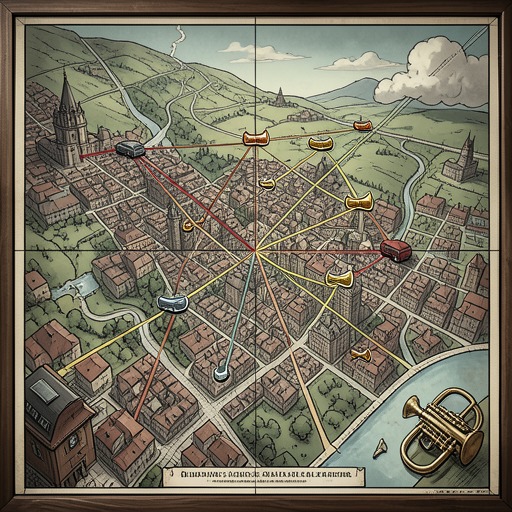
The Crying of Lot 49“WE AWAIT SILENT TRISTERO’S EMPIRE” is the motto on an old American stamp bearing the muted post horn and a badger. Shown to Oedipa Maas by Genghis Cohen, the stamp turns the name Tristero into a declared, if still elusive, political horizon: an underground postal network that once opposed state-backed carriers and later survived through concealment. Its motto sounds like a promise of eventual power, but the history Oedipa hears describes an organization increasingly committed to silence and disguise.
The Stamp and Its Provenance
Cohen receives the stamp through a friend in San Francisco. The friend cannot find it in the stamp catalogue, but the copy Cohen consults contains a pasted-in addendum identifying it as stamp 163L1, “Tristero Rapid Post, San Francisco, California.” The entry is assigned a place between two New York local-post listings. Oedipa notices that the catalogue’s endpaper bears a sticker from Zapf’s Used Books, connecting the stamp to a shop—and a shopping center—owned by Pierce Inverarity. That connection makes the artifact suggestive, not conclusive: Oedipa recognizes that someone could have pasted in the addendum.
The stamp’s evidentiary force depends on its material form as much as its wording. Earlier, Cohen had examined a 1940 Pony Express commemorative under magnification and identified a watermark on its reverse; the later stamp likewise presents Tristero through a postal object whose authenticity and classification matter. The motto is therefore both a message and a clue embedded in a medium that can be altered, overlooked, or miscatalogued.
The Postal Conflict Behind the Motto
Oedipa’s account of Tristero begins with its opposition to the Thurn and Taxis postal system in Europe. In the United States, it was said to have fought the Pony Express and Wells, Fargo, at times operating as masked outlaws or disguising its messengers as Indigenous people. The historical record is fragmentary: at Fangoso Lagoons, a marker recounts an 1853 attack on Wells, Fargo men by masked marauders in black, witnessed by a post rider who died soon afterward. The sole further clue was a cross—or, Oedipa wonders, perhaps the initial T—traced in dust by a victim.
Emory Bortz places Tristero’s American survival against postal reform and federal suppression of independent carriers. Fallopian’s research links the Civil War to reforms beginning around 1845, arguing that successive acts drove private routes toward financial ruin and that the federal government moved vigorously against surviving competitors in 1861. Bortz’s later account suggests that Tristero’s refugees, arriving from Europe in 1849–50, remained underground rather than resume open competition. By 1861, he says, its strategy had shifted toward silence, impersonation, and opposition disguised as allegiance: messengers learned Indigenous languages and traveled west in disguise while the Pony Express crossed the same broad frontier openly.
A Promise Made Quiet
The motto’s “silent” empire condenses that change in method. Fallopian describes a small private-mail experiment within the San Narciso chapter of the Peter Pinguid Society: its members use Yoyodyne’s internal delivery system covertly, but carriers are hard to retain, schedules are tight, and plant security is alert. The group’s local operation is limited, with similar pilot projects reported in Washington and Dallas. This is a separate contemporary channel, but its secrecy and dependence on indirect routes echo the larger history Oedipa is trying to assemble.
Other appearances of the muted post horn extend the pattern without settling its meaning. A notice in a restroom directs readers to contact someone through WASTE, and Oedipa later finds the emblem among the people she encounters in San Francisco. An anonymous member of Inamorati Anonymous recounts how a stamp’s image became the group’s emblem after gasoline dissolved the printing on stamps in an executive’s pocket; the founder then established a society of isolates. These episodes place the symbol in several networks and contexts, making it difficult to treat any one sighting as proof of a single organization.
Meaning and Uncertainty
The stamp appears to offer a declaration from an organization that has endured political defeat by changing its outward form. Yet its force remains compromised by the possibility of forgery, the uncertain provenance of Cohen’s copy, and Oedipa’s own entanglement with Inverarity’s estate. The book does not resolve whether Tristero exists independently or whether Oedipa is connecting scattered signs into a pattern. The motto consequently functions less as a verified announcement than as the investigation’s concentrated promise and threat: an empire awaited in silence, whose presence can be inferred from marks on paper but not securely established.